

Il chiromante
| Autore | Pietro Della Vecchia |
|---|---|
| Periodo | (Vicenza ? 1602/1603 - Venezia 1678) |
| Datazione | 1650 |
| Supporto | Tela, 148,5x219 |
| Inventario | A 501 |
| Autore della scheda | Enrico Maria Dal Pozzolo |
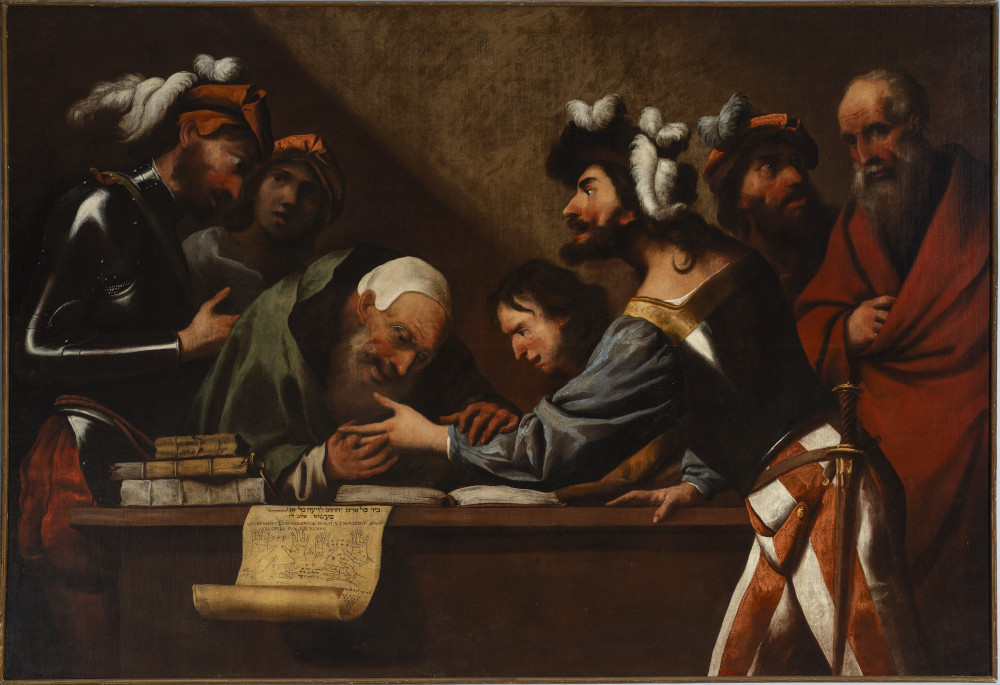
Un vecchio indovino, attorniato da alcuni stravaganti personaggi, legge la mano di un soldato: il responso genera stupore e sconcerto nei suoi compagni di ventura, sgomento nei due anziani sulla destra, timore e allarme negli occhi dello sventurato armigero. Il chiromante consulta uno dei quattro pesanti volumi posati sul suo tavolo e una pergamena, srotolata verso lo spettatore, in cui compaiono un versetto, scritto in ebraico e in latino, ricavato dal Libro di Giobbe (37, 7: “Sulla mano di ognuno pone un sigillo, perché tutti riconoscano la sua opera”) e una serie di palme di mano affiancate, probabilmente, da segni cabalistici. La sentenza è chiara: il destino voluto da Dio è scritto nelle mani di ciascun uomo.
Il dipinto, realizzato presumibilmente poco dopo il 1650, è uno dei capolavori di Pietro della Vecchia. Si tratta di un’opera enigmatica e, allo stesso tempo, grottesca e bizzarra, uscita dai pennelli di un artista eclettico e colto, influenzato, da un lato, dalla pittura dei “tenebrosi” caravaggeschi, dall’altro dalla grande tradizione artistica del Cinquecento veneto: Tiziano, Romanino, Dosso e in particolare Giorgione di cui Vecchia fu un abile falsificatore.
La tela affronta quindi un tema filosofico-esistenziale in tono ironico, facendo riferimento alla cabala e alla magia e mostrando alcuni dei personaggi che più frequentemente ricorrono nella pittura dell’artista: guerrieri, paggi con cappelli piumati e coppie di amanti.
Il dipinto giunse in Museo nel 1834, insieme alle altre opere d’arte appartenenti alla collezione che il nobile vicentino Carlo Vicentini Dal Giglio lasciò alla Pinacoteca della sua città.
Iscrizioni
sul recto, sul foglio [scritta in ebraico]/ QUI IN MANU DIUM HOMINUM SIGNAT, UT NOVERINT SINGU/ LA OPERA SUA IOB. XXXVII; altre scritte sul foglio e su uno dei volumi chiusi a sinistra
Cartellini
s.d.2 60; 1949-1950 N.501/ Pietro Vecchia/ […]/ tela […]x2,15; 1954 8513; su carta bianca, a stampa con inchiostro nero INTERLINEA/ FINE ARTS PACKERS/ F.108/ TITOLO DELL’ OPERA “IL CHIROMANTE”/ DI P. VECCHIA/ EX CIVICI MUSEI VICENZA; su carta bianca, a stampa con inchiostro nero 501;
Provenienza
legato Carlo Vicentini Dal Giglio, Vicenza 1834
Restauri
1958, Giuseppe Giovanni Pedrocco; 1999, Egidio Arlango
Inventari
1834: 20. Pietro Vecchia. Astrologo con varie figure, in tela senza cornice. Lire 240; [post1834]: 43. Pietro Vecchia. Astrologo con varie figure, 161; 1854: 161. 1.50. 1.20. Pietro Vecchia. Astrologo con varie figure; [1873]: Stanza di Pio VI, prima stanza a tramontana, parete a destra dello ingresso, 3. Pietro Vecchia nato 1605, morto 1678. Il chiromante [corretto su mago che predice la sorte di alcuni giovani soldati]; 1873a: c. 4, 3. Pietro Vecchia. Un chiromante circondato da varie persone; 1902: c. 17, 74 (68). 66. Un chiromante circondato da varie persone. Tela ad olio. Alto 1.50, largo 2.18. Pietro Vecchia. Non buono. Non buona. Legato Vicentini Dal Giglio. Da pulirsi; 1907: c. 8, 66 (68). Pietro Muttoni (detto Vecchia), nacque a Venezia nel 1605 e morì nel 1678; fu allievo di A. Varotari (Padovanino). Un chiromante circondato da varie persone. Tela, 1.50x2.18; 1908: 68 (525, 501). Pietro Muttoni detto Vecchia. Un chiromante circondato da varie persone (tela, 1.50x2.18). Nel 1908 si trova nella prima stanza a sinistra. Nel 1873 si trovava nella stanza del re al n. 3. Nel catalogo a stampa del Magrini dell’anno 1855 si trova al n. 31 della prima stanza a tramontana. Nell’inventario di consegna della Pinacoteca al Museo dell’anno 1854 si trova al n. 161 colle indicazioni: Pietro Vecchia, Astrologo con varie figure, 1.50x2.20. Pervenne alla Pinacoteca nel 1834 per legato Vicentini Dal Giglio col n. 20 e le indicazioni: Pietro Vecchia, Astrologo con varie figure, tela senza cornice, 1.50x2.20; 1910-1912: 501, aggiunta 1954. Numerazione vecchia: 501 inventario 1950. Provenienza: legato Vicentini Dal Giglio. Forma e incorniciatura: rettangolare. Dimensioni: 1.49x2.15. Materia e colore: tela dipinta ad olio. Conservazione e restauri: 1958 prof. G. Pedrocco foderatura, sostituzione del telaio, pulitura, restauro pittorico. Descrizione: Chiromante circondata da molte persone e guerrieri. Autore: inventario 1950 Pietro Vecchia.
Descrizione tecnica
Fin dall’inventario del lascito Vicentini Dal Giglio cui appartenne (al pari di quasi tutti gli altri pezzi dell’artista pervenuti in Museo) questa grande tela fu concordemente attribuita a Pietro della Vecchia e rappresenta, in effetti, uno dei suoi capolavori, databile forse poco oltre il 1650.
Intorno al tavolo di un vecchio chiromante, nel chiuso di una stanza, si stringono sei personaggi la cui mimica esprime sconcerto e allarme: evidentemente la lettura della mano del soldato al di qua del tavolo ha condotto a conclusioni pessime sul suo futuro, avendo compulsato quattro grossi volumi, uno dei quali è rimasto aperto, e un cartiglio che si apre verso l’esterno, consentendone la lettura allo spettatore: in esso appaiono due scritte - la prima in ebraico e la seconda in latino, ricavate dal Libro di Giobbe (37,7: “Sulla mano di ognuno pone un sigillo, perché tutti riconoscano la sua opera”) - e i disegni delle palme di sei mani, accompagnate da segni forse cabalistici.
Si tratta di opera emblematica di Vecchia, per la compresenza di tre delle componenti fondamentali della sua cultura: le radici caravaggesche, la rielaborazione di formule di matrice genericamente giorgionesca e il richiamo a dibattiti di carattere esoterico.
Va detto anzitutto che una composizione di questo tipo nasce chiaramente da schemi caravaggeschi ricavati sia dagli archetipi del Merisi (cui non mancano allusioni precise: dal tema generale chiromantico - che si fonda sulla Buona Ventura del Louvre - fino a spunti che rinviano alla Vocazione di Matteo in San Luigi dei Francesi, anche in dettagli come lo spicchio di luce che taglia la parete), ma soprattutto dalla sua cerchia, specificamente quella, costituita per lo più da artisti transalpini, che il giovane maestro poté frequentare nell’Urbe assieme al suo futuro suocero, Nicolò Renieri. Il taglio dell’immagine è affine a esempi di Bartolomeo Manfredi come la Lettura della mano già alla Gemäldegalerie di Dresda e al perduto Cinque sensi (Nicolson, 1989, II, ill. 303, 305), opere certamente note al Vecchia, considerando la ripresa di un soldato da quest’ultimo nella giovanile Crocifissione in San Lio a Venezia (Aikema, 1990, p. ***, ill. 1); e ancora di Valentin negli esemplari già Matthiesen a Londra, del Louvre e già in collezione Aldovrandi a Bologna (Nicolson, 1989, II, pp. *****, ill. 675, 700, 710) e, per l’appunto, di Renieri, nella Lettura della mano già a Berlino e in altra redazione a Budapest (Nicolson, 1989, III, pp. *****, ill. 949-950). Sorge perfino il sospetto che, al di là dell’impatto che simili ideazioni possano aver lasciato nell’animo del giovane Pietro di ritorno a Venezia, un qualche peso nella loro costante riproposizione commerciale possa averlo avuto all’inizio proprio il suocero, pittore e mercante d’arte che fu ispiratore - secondo una testimonianza ben nota (Procacci, 1965, p. 107) - di alcune realizzazioni del genero. Su tale matrice caravaggesca quest’ultimo innestò tutto quel variegato repertorio di personaggi, in bilico tra l’omaggio colto al grande cinquecento veneto - tra Giorgione, Tiziano, Romanino, Dosso - e una sua mordente parodia: quasi ognuna delle teste esagitate della tela vicentina fu riutilizzata in opere a sé stanti o di diverso formato. Iconografie di questo genere, fuori dal catalogo di Vecchia (se si eccettuano due poco noti dipinti dell’ambito di Padovanino, conservati rispettivamente al Museo di Warschan, inv. 186690, e a Potsdam, Sanssouci, inv. GKI 949, come forse dello stesso Vecchia), furono quasi un unicum nel contesto veneto seicentesco, e la loro costante reiterazione da parte del maestro e della sua cerchia attesta una chiara fortuna commerciale e di committenza (per un elenco di sette redazioni autografe e di bottega, Aikema, 1990, pp. 141-142).
Non è del tutto chiaro tuttavia il senso iconologico propriamente espresso da opere di questo genere. Va detto che, come già rilevato dalla critica (Wind, 1974, p. ***; Calvesi, 1990, pp. 228-230; Bottacin, p. ***, 2002), il tema della Buona Ventura negli originali di Caravaggio e dei suoi primi seguaci era investito da una ventata di patente ironia, insistendo sul concetto dell’inganno dell’ingenuo credulone: non per nulla pendant (reale o ideale) dell’archetipo del Merisi già nella collezione del cardinal Del Monte erano appunto I bari. Si osservi peraltro che in questi casi la protagonista era sempre una zingara, talvolta accompagnata da una complice ladra (come nell’esemplare recentemente accertato a Vouet in Palazzo Barberini: Vodret, in Caravaggio e i suoi…, 1999, pp. 58-59, cat. 16); mentre in tutti i casi del maestro veneto a leggere la mano è sempre un vecchio contraddistinto da una particolare cuffia bianca. Tale figura venne verosimilmente ripresa da un’incisione di ambito caravaggesco dedicata al Cavalier d’Arpino (Calvesi, 1990, p. ***, ill. 65) in cui l’episodio chiromantico era accompagnato da una scritta pure alludente al pericolo dell’inganno (“Fur demon mundus senex fraudemque caro parat inventa tria sunt haec fugienda viro”: tre cose sono da fuggire, il demonio ladro, la vanità e la carne che trama inganni in gioventù). Ma se è indubbio che tale direzione semantica dovrebbe essere stata in qualche misura condivisa dallo stesso Vecchia, sorge tuttavia motivatamente il dubbio che la scelta di apporre in plateale evidenza la citazione biblica da Giobbe, con un versetto che dichiara come il destino voluto da Dio sia scritto sulle mani di ognuno, non vada affato inteso come avallo all’appena ricordato diffuso scetticismo su tale pratica, bensì come segno della condivisione di certo agnosticismo che caratterizzava uno degli ambienti più anticonformisti di Venezia e d’Italia: quello dell’Accademia degli Incogniti di Gian Francesco Loredano, con cui il pittore fu in sicuro contatto, come ampiamente dimostrato da Aikema (1990; in seguito, sugli Incogniti, Miato, 1998 e Menegatti, 2000).
Comunque sia, è chiaro che anche iconografie di questo genere affrontano questioni di carattere filosofico ed esistenziale in termini palesemente ironici e grotteschi. Va altresì evidenziato come spesso in simili composizioni del Vecchia si riconosca una netta contrapposizione tra studiosi decrepiti e armigeri nel pieno della loro virilità, ovvero fra sapienza e forza. Nel suo pittoresco teatrino, il maestro fa di volta in volta prevalere le qualità intellettuali e/o persuasive - come nel caso della presente tela - o, viceversa, lo sconquasso prodotto da un’irrefrenata violenza. Ius in armis, il diritto è nelle armi, è il titolo da lui stesso specificato in una sua fortunata composizione giuntaci in più esemplari (Aikema, 1990, p. 139, cat. 156), che sembra quasi il seguito, o la risposta, al più o meno profondo tentativo di riflessione sul senso della vita evocato da scene come questa vicentina.
Bibliografia
Magrini, 1855, p. 55, n. 31; Restauri…, 1958, p. 263; Barbieri1, 1962, pp. 176-177; Moir, 1967, I, p. 285, II, p. 89, ill. 385; Meijer, 1972, ill. 59; Pallucchini, 1981, I, p. 177; Ballarin An., 1982, p. 121; Aikema, 1990, pp. 67, 141; Parisio, 1991, p. 85; Barbieri, 1995, p. 95; Casadio, in Antonio Carneo…, 1995, 174-176, cat. 45; Saccomani, in Da Padovanino…, 1997, p. 140, cat. 50; Binotto, 2000, p. 285 (c. 1650); Aikema1, 2001, p. 53; Villa, in Palazzo Chiericati…, 2004, pp. 26-27.
Esposizioni
Portogruaro, 1995, pp. 174-175, cat. 45; Padova, 1997, p. 140, cat. 50.