

Cristo crocifisso con la Madonna, i santi Giovanni evangelista e Battista, la Maddalena e due abati cistercensi
| Author | Hans Memling |
|---|---|
| Period | (Seligenstadt, Magonza, 1440 circa - Bruges 1494) |
| Dating | 1468 - 1470 |
| Support | Tavola, 84,5x66 |
| Inventory” | A 297 |
| Sheet autor | Maria Elisa Avagnina |
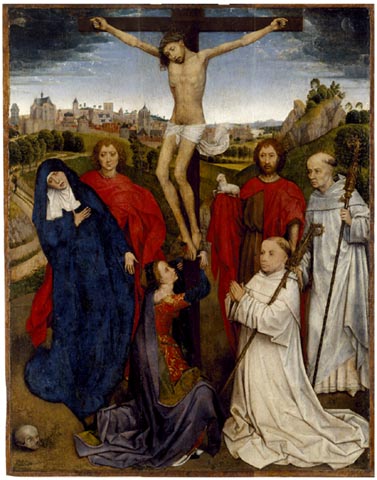
Questa tavola costituiva originariamente il pannello centrale di un trittico di ridotte dimensioni (complessivamente cm. 83x116 circa senza le incorniciature) smembrato in epoca imprecisata. Si tratta di un vero e proprio capolavoro, la cui preziosità emerge da alcuni particolari di qualità altissima: la drammaticità dei volti dei santi a cui si contrappone la forte caratterizzazione dei visi dei due abati cistercensi, la resa plastica e dinamica dei panneggi, la lucentezza dei colori, il fiabesco paesaggio che si distende alle spalle del Crocifisso. Sono questi gli elementi caratteristici della pittura fiamminga “così lucida e dettagliata, così apparentemente naturalistica e in realtà tutta costruita e celebrale” (Villa), che verranno in breve tempo recepiti, assieme alla tecnica ad olio, dagli artisti italiani della seconda metà del Quattrocento (fra tutti Piero della Francesca, Antonello da Messina e Giovanni Bellini).
L’opera, originariamente attribuita al maestro fiammingo Jan Van Eyck ed assegnata dal 1892 ad Hans Memling, risale probabilmente agli anni 1468-1470. In questo periodo il giovane Memling iniziò a dirigere una propria bottega a Bruges, affermandosi come artista indipendente, pur rimanendo ancora legato al linguaggio del suo maestro Roger van der Weyden, come dimostrano alcuni particolari della tavola vicentina: i contorni precisi e taglienti che definiscono le figure, l’irreale sfondo paesaggistico, il corpo asciutto del Cristo e l’elegante figura della Maddalena. Inginocchiato ai piedi della croce, è raffigurato il committente del trittico, l’abate cistercense Jan Crebbe titolare dell’abbazia delle Dune a Coxyde, che avrebbe ordinato l’opera per celebrare il quindicesimo anno della sua prelatura. Alle sue spalle compaiono il suo santo protettore il cistercense san Bernardo e san Giovanni Battista.
Labels
s.d.3 Cat. N° 297/ Hans Memling/ Cristo in croce; 1949-50 N. 297/ Hans Memling/ Il Calvario/ tavola 78x63
Provenance
dono dei conti Matteo e Ludovico Folco, Vicenza 1865 (MCVi, Museo, Registri di protocollo, reg. 1, prot. n. 514 del 1865, giu. 5, la Commissione alle cose patrie della città di Vicenza “esorta i nobili fratelli Matteo e Lodovico Folco ad offrire al civico Museo alcuno de’ rari dipinti di loro famiglia”; prot. n. 516 del 1865, lug. 15, la Commissione alle cose patrie della città di Vicenza “ringrazia la nobile famiglia Folco del dono fatto al Museo di una tavola antica con su dipintovi il Crocefisso ed alcuni santi”)
Restorations
1946, Mauro Pelliccioli; 1987, Corest
Inventories
[1873]: Stanzino antichi, terza stanza a tramontana, parete I, 1. Giovanni Van-Eyck detto Abekr nato nel 1370, morto nel 1460 circa, scoperse il segretto del dipingere a olio circa il 1410, chiamavasi anche Giovanni da Brugges. Cristo in croce con Maria vergine, san Giovanni evangelista, san Giovanni Battista, santa Maria Maddalena e due abbati certosini. In tavola; 1873a: c. 6, 1. Giovanni Van Eyck nato 1380, morto 14<6>0. In tavola. Gesù Cristo in croce con Maria vergine, san Giovanni evangelista, san Giovanni Battista, santa Maria Maddalena e due abbati certosini; 1902: c. 55, 256 (247). 249. Cristo in croce, le Marie [corretto su e santi], i due san Giovanni e due prelati. Tavola ad olio. Alto 0.83, largo 0.64. Hans Memling. Buono. Deperita. Dono dei fratelli conti Matteo e Lodovico Folco. Frammento di un’ancona; 1907: c. 28, 249 (247). Hans Memling, nacque nel 1430 a Mömlingen, presso Magonza, e morì a Bruges l’11 agosto 1494; fu allievo di Ruggero van der Weyden. Cristo in croce, le Marie, i due san Giovanni e due prelati. Tavola, 0.82x0.64. Dono dei fratelli conti Matteo e Lodovico Folco. Frammento di un’ancona; 1908: 247 (297). Hans Memling. Cristo in croce, le Marie, i due Giovanni e due monaci (frammento di un’ancona, tavola, 0.82x0.64). Nel 1908 si trova nella terza stanza a sinistra. Nel 1873 si trovava nella stanza degli antichi al n. 1 coll’attribuzione: Giovanni Van-Eyk. Pervenne al Museo il 15 luglio 1865 dalla nobil famiglia Folco, che attribuiva il dipinto alla scuola fiamminga; [segue la nota di mano successiva confronta Cristo deposto di Quentin Matyys nella cattedrale di Anversa]; 1910-1912: 297 (303). Numerazione vecchia: 247 numerazione della Commissione d’inchiesta 1908; 257 catalogo 1902; 1 catalogo 1873; 297 catalogo 1912; 297 catalogo 1940; 297 inventario 1950. Provenienza: dono dei fratelli conti Matteo e Lodovico Folco 1865. Collocazione: sala degli stranieri. Forma e incorniciatura: rettangolare con cornice. Dimensioni: 0.82x0.62; inventario 1950 0.78x0.63. Materia e colore: tavola (ad olio?). Confronti: confronta il Cristo deposto di Quentin Matyys nella cattedrale di Anversa. Conservazione e restauri: restauro Pelliccioli 1946. Descrizione: Cristo in croce, le due Marie, i due Giovanni e due monaci bianchi con veduta di una città nello sfondo (è il frammento di un’ancona). Data: circa 1470. Autore: pervenne con l’attribuzione a scuola fiamminga; nel catalogo 1873 era attribuito a Van Eyk; nel catalogo 1902 fu attribuito a Hans Memling; nelle regie Gallerie di Venezia si conserva una copia del nostro dipinto n. 189 (pag. 65 catalogo Paoletti) con l’indicazione copia antica del Memling, l’originale mutilato si trova oggi al Museo di Vicenza; catalogo 1912 Hans Memling; catalogo 1940 Hans Memling; inventario 1950 Hans Memling; Pallucchini 1946, parte centrale di un altarolo le cui ali laterali raffiguranti la donatrice presentata da una santa e il donatore presentato da san Guglielmo sono alla Libreria Morgan di Nuova York (ciascuna 0.81x0.30); alla Ca’ d’Oro esiste un’antica copia dell’intero altarolo, è probabile quindi che tutta l’opera si trovasse originariamente nel Veneto, i laterali prima di giungere alla raccolta americana facevano parte della parigina collezione Kann. Iconografia: foto Alinari 13512; foto Fiorentini (Venezia) CN 4567.
Technical description
Del dipinto, pervenuto alle raccolte civiche nel luglio del 1865, per dono dei conti vicentini Matteo e Ludovico Folco, non si conoscono allo stato attuale degli studi le vicende immediatamente precedenti la donazione.
La tavola costituiva in origine il pannello centrale di un trittico di contenute proporzioni (complessivamente cm.83x116 circa senza le incorniciature), completato da sportelli laterali raffiguranti sul versante sinistro interno una Vecchia donatrice con sant’Anna e su quello destro un Donatore con san Guglielmo di Maleval, oggi entrambi alla Pierpont Morgan Library di New York e decorati sui dorsi esterni da un’Annunciazione in grisaille “naturale”o “viva”, conservata attualmente al Groeningemuseum di Bruges (inv. 0.1254-1255) (per una ricostruzione completa della struttura e delle vicende dei vari elementi del trittico: De Vos¹, 1994, pp. 42-45).
Il complesso fu smembrato in epoca imprecisata e le ante laterali furono resecate per vendere separatamente le diverse tavole, secondo una pratica piuttosto diffusa a partire dal XVIII secolo (De Vos, in Hans Memling…, 1994, p. 42). Dell’opera nella sua interezza esiste presso le Gallerie dell’Accademia di Venezia una copia di anonimo (inv. 141), al presente in deposito alla Cà d’Oro, riproducente in un’unica composizione, senza partizioni verticali, l’interno del trittico ancora integro. La tela, già ritenuta dalla Moschini Marconi (1955, p. 184, n. 207) e da Barbieri (1962, I, p. 147) una copia antica, forse di mano fiamminga, risalente con probabilità agli inizi del secolo XVI e considerata da Pallucchini (1946, p. 96) interessante indizio di una presenza ab antiquo del trittico in Veneto, è stata giudicata da De Vos (in Hans Memling…, 1994, pp. 45 e 246, cat. 97) di esecuzione fredda e precisa e riferita per tale ragione alla fine del secolo XVIII, quando l’opera doveva trovarsi già in una collezione privata italiana e fu copiata probabilmente per fissarne il ricordo prima dello smembramento per la vendita.
La pertinenza degli sportelli laterali alla tavola del Calvario di Vicenza, avallata dalla copia veneziana, oltre che provata dalla congruenza compositiva e tecnico-stilistica dei tre elementi, è stata inspiegabilmente messa in dubbio da Kämmerer (1899, pp. 73-74), che pure è il primo a fornire la descrizione dell’interno del trittico, seguito nel parere da Voll (1909, p. 172).
Quanto all’identità dei personaggi stretti intorno alla croce, oltre alla Vergine, san Giovanni Evangelista e Maria Maddalena, rientranti nell’iconografia consueta della Crocifissione, il monaco in abito cistercense e con l’attributo del pastorale, protetto da san Giovanni Battista e da san Bernardo e inginocchiato nell’atteggiamento tipico dell’offerente nell’evidenza del primo piano, è stato identificato da Renders (1940) con Jan Crabbe, ventiseiesimo abate dell’abbazia delle Dune a Coxyde (1457-1488), che avrebbe commissionato il trittico nel 1472 per celebrare il quindicesimo anno della sua prelatura. L’identificazione, rimasta a lungo ignorata dalla critica, compreso lo stesso Barbieri (1962), è condivisa senza riserve da Dubois-Huyghebaert (1966) e ritenuta da De Vos (in Hans Memling…, 1994, p. 42) altamente plausibile sotto il profilo cronologico, essendo Crabbe l’unico abate cistercense fiammingo di nome Jan al tempo di Memling e, forse, uno dei protettori stessi dell’artista (De Vos, in Hans Memling…, 1994, p. 15). Conseguentemente, nelle due figure inginocchiate delle ante laterali sono state riconosciute dallo stesso Renders la madre e il fratello dell’abate, Anna e Guglielmo, introdotti dai santi omonimi. L’ipotesi, possibile, ma non provata (potrebbe trattarsi più genericamente di due ricchi benefattori dell’abbazia), sostituisce quella inattendibile di Kämmerer, secondo cui nei due personaggi sarebbero rappresentati Wilhem Vrelant, decano della corporazione dei miniaturisti di Bruges e la moglie di questi. Di Jan Crabbe esiste un ritratto contemporaneo (1480 circa) insieme a Maria di Borgogna, oggi al Grand Séminaire di Bruges, ma proveniente dall’abbazia delle Dune di Coxyde, facente parte di una serie di diciassette grisailles raffiguranti principi e abati, in cui i tratti fisionomici dell’effigiato, per quanto più vecchio di circa un decennio e gravato da un’ingombrante mitra, non sembrano comunque inconciliabili con quelli riprodotti nella tavola vicentina.
In merito alla collocazione originaria del trittico, è stata avanzata l’ipotesi (Geirnaert, 1989, p.180) che esso costituisse la pala d’altare della cappella di rappresentanza dell’abbazia delle Dune a Bruges, dedicata alla gloriosa Vergine Maria e ai santi Giovanni Battista, Giovanni Evangelista e Bernardo, in cui Jan Crabbe, stando alla cronaca dell’abbazia, aveva istituito il 14 luglio 1479 la consuetudine di celebrare una messa giornaliera, ma la proposta, per quanto suggestiva, è stata giudicata da De Vos (in Hans Memling…, 1994, p. 42) poco convincente sia per il soggetto mariano “doloroso” e non “glorioso” della tavola centrale, come vorrebbe la dedicazione, sia per la datazione più tarda che comporterebbe per l’opera, in prossimità del Trittico Floreins del 1479.
Attribuito in passato a Van Eyck, come risulta dagli inventari museali, il Calvario è stato per la prima volta riferito a Memling nella sua fase giovanile da Burckhardt (1892) e in seguito ritenuto tale per giudizio pressoché unanime della critica, fatta eccezione per Voll (1909, p.179) che ne mette in dubbio l’autografia. Friedländer (1934, p. 114) lo data al 1470 e lo dice tratto (1956, p. 48) da un non meglio identificato prototipo di Rogier Van der Weyden; De Vos tende ad anticiparlo tra il 1467 e il 1470. Bock (1900) vi ravvisa un’influenza della scuola di Colonia, riconducibile alle origini renane del pittore, condivisa dalla critica successiva (De Vos¹, 1994, p. 357).
Qui Memling, all’epoca all’incirca trentenne e da poco affermatosi come pittore indipendente a Bruges nel 1465, dopo una permanenza non documentata ma generalmente ammessa nella bottega di Van der Weyden, denuncia un sensibile influsso del grande artista brussellese nei profili lineari secchi e taglienti, nel tono fiabesco del fondale paesistico e nelle tipologie dei personaggi, in particolare nella spoglia prosciugata del Cristo e nella figura elegante e appassionata della Maddalena. Accanto a questi tratti affiora tuttavia nel dipinto un principio di “distensione della plastica drammatica del maestro verso una dolcezza di forme, una intimità di espressioni e una grandiosità di spazio nell’evocazione del paesaggio“ (Pallucchini, 1964, pp. 95-96) che costituiranno la cifra distintiva della produzione di Memling. Il pathos, decantato, si scioglie nel gruppo dei dolenti a sinistra in accenti di manierata elegia, appena contraddetta nei personaggi sulla destra dal pungente realismo della fisionomia di Crabbe e del volto emaciato di san Bernardo. Il timbro formale raffinatissimo è affidato, oltre che all’eleganza della linea, alla regia cromatica che accosta colori brillanti con effetti di intarsio smaltato, ancora apprezzabili nonostante le abrasioni e i danni subiti dalla pellicola pittorica.
Dal punto di vista strutturale il dipinto risulta composto da tre tavole (De Vos riporta erroneamente nove) di quercia disposte verticalmente. Sottoposto ad indagini riflettografiche all’infrarosso, ha rivelato la presenza di un disegno sottostante eseguito con pennelli di spessore diverso e l’impiego di un medium liquido e scuro, un inchiostro, abbinato talora al carboncino. L’impalcato disegnativo, tracciato con immediatezza e libertà che sembrano contraddire la meticolosa finitezza della realizzazione pittorica, documenta un assetto originario diverso della composizione sulla parte destra della tavola guardando, dove l’agnello ora sorretto dalla mano destra del Battista era in origine posto davanti alla spalla sinistra del santo e il volto di san Bernardo risultava più spostato verso il margine destro del dipinto (sezione scientifica, scheda 2).Una tecnica grafica siffatta, sommaria e a larghe linee, tipica delle prime opere dell’artista, come la Madonna di Kansas City e il Giudizio Universale di Danzica, e sostituita nella produzione successiva da un disegno più nervoso e spezzato, risulta straordinariamente prossima alle convenzioni disegnative in uso nella bottega di Roger Van der Weyden, concorrendo a confermare, insieme alle analogie stilistiche e iconografiche, l’ipotesi dell’alunnato di Memling presso di lui.
Bibliography
Catalogo dei doni…, 1866, p. 16 (antica scuola fiamminga); Ciscato, 1870, p. 86 (Van Eyck); Elenco dei principali..., 1881, p. 8 (Van Eyck); Burckhardt, 1892, p. 634; Kämmerer, 1899, pp. 68, 73-74; Bock, 1900, pp. 158-159; Burckhardt, 1901, II, parte III, p. 738; Weale, 1901, pp. 66-67, 102; Voll, 1909, p. 172, n. 26, p. 179, n. 156; Ongaro, 1912, p. 101; Frizzoni, 1913, p. 192; Bortolan-Rumor, 1919, p. 153; Friedländer, 1928, pp. 21, 114-115; Voss, 1930, p. 375; Peronato¹, 1933, p. 74; Arslan, 1934, p. 13; Goffin, 1934, XXII; Fasolo, 1940, p. 174; Renders, 1940; Winkler, 1940, pp. 248-249; von Baldass, 1942, pp. 13, 36-37; Guthrie, 1946, p. 256; Pallucchini¹, in I capolavori…, 1946, pp. 96-98, cat. 164; Pallucchini², in I capolavori…, 1946, pp. 95-97, cat. 164; Podestà, 1946, p. 165; Collobi-Ragghianti, 1948, p. 34, cat. 5; Arslan, 1949, p. 72; Friedländer, 1949, p. 33; I Fiamminghi…, 1951, p. 35, cat. 11; Van Gelder, 1951, p. 327; Barbieri, 1952, p. 8; Ronci, 1952, p. 92; Magagnato, 1953, p. 173; Barbieri², 1954, p. 172; Barbieri³, 1954, p. 39; Moschini- Marconi, 1955, p. 184, cat. 207; Barbieri-Magagnato, 1956, p. 173; Friedländer, 1956, pp. 48, cat. 50; Mallè, 1958, pp. 329-330; Janssens de Bisthoven, (1957) 1959, cat. 12a; Pauwels, 1960, cat. 10; Dubois- Huyghebaert, 1966, pp. 403-405; Faggin, 1966, s.p.; Faggin 1969, p. 95 cat. 20d; De Vos, (1979) 1982, pp. 163-165; Lane, 1980, n. 3; Ballarin An., 1982, p. 64; De Vos, 1987, p. 12; Geirnaert, 1989, pp. 174-183; Châtelet, 1992, p. 578; De Vos¹, 1994, pp. 90-93 nn. 5, 357, 362, 364; De Vos, in Hans Memling…, 1994, I, pp. 42-45, n. 3; id., II, pp. 68, 79; Barbieri, 1995, pp. 44-46; Borchert, 1996, p. 26; Limentani Virdis, 1997, p. 15; Rigoni, 1997, p. 157; Galassi¹, 1999, pp. 7-24.
Exhibitions
Venezia, 1946, p. 96, cat. 164; Bruges- Venezia- Roma, 1951, p. 35, cat. 11; Bruges, 1994, pp. 42- 45, cat. 3.