

Flagellazione
| Author | Alessandro Maganza |
|---|---|
| Period | (Vicenza 1548 - 1632) |
| Dating | 1600 - 1620 |
| Support | Pietra di paragone, 44x33 |
| Inventory” | A 135 |
| Sheet autor | Francesca Lodi |
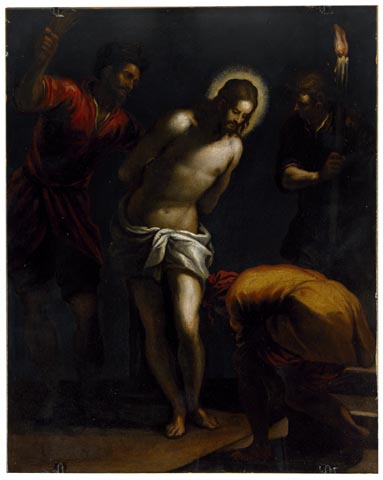
Il dipinto giunse in Museo insieme alle altre opere appartenenti alla ricca raccolta di quadri che la nobile vicentina Paolina Porto Godi lasciò alla Pinacoteca della città di Vicenza (1825-1831).
Alessandro Maganza offre qui un’interpretazione intensa e drammatica della Flagellazione di Cristo. La scena si concentra sui personaggi essenziali, la vittima e i suoi aguzzini. Le figure emergono dall’oscurità dello sfondo in forza della luce e del colore denso e opaco. L’atmosfera notturna, ottenuta grazie alla tecnica della pittura stesa sulla pietra di paragone, è rischiarata dai rapidi ed improvvisi bagliori che, generati dalla torcia posta sulla destra del dipinto, illuminano i corpi dei carnefici e dal chiarore che riverbera dall’aureola, dalle carni bianche e dal perizoma di Cristo.
I sapienti rapporti di luce e ombra e gli effetti del colore rivelano come, oltrepassato il Cinquecento, si apra, in ambito pittorico, una nuova epoca, caratterizzata da esecuzioni dense di retorica che non rispecchiano più una relazione immediata con la realtà, ma che esprimono tramite studiati giochi di luce e calibrati rapporti cromatici “l’emotività del colore e la plasticità della materia” (Villa).
La pittura del Seicento riflette dunque l’affermarsi in campo artistico di un gusto e di una sensibilità nuovi, ormai lontani dagli esiti dell’arte rinascimentale, cioè “dall’equilibrio, dall’armonia anche drammatica e pur sempre umana della classicità” (Villa).
Provenance
legato Paolina Porto Godi, Vicenza 1826
Restorations
1958, Giuseppe Giovanni Pedrocco; 1997, Antonio Bigolin
Inventories
1826: 36. Camera a mattina sopra il Corso. Cristo alla colonna, sul paragone. Maganza. Lire 12; 1831: 92. Nella sala detta del Consiglio. Maganza. Cristo alla colonna dipinto sul paragone. Galleria Porto, n. 4321 del 1826, 36; [post1834]: 207. Maganza. Cristo alla colonna, sul paragone, 33; 1854: 33. 0.55. 0.47. Maganza. Cristo alla colonna sulla pietra; [1873]: Seconda stanza a tramontana, parete a sinistra entrando, 60 (62). Alessandro Maganza nato 1556, morto 1630. Gesù Cristo alla colonna. Sul marmo; 1873a: c. 5, 60. Alessandro Maganza. La flagellazione di Gesù Cristo; 1902: c. 42, 197 (187). 188. Flagellazione. Marmo ad olio. Alto 0.42, largo 0.34. Ignoto veronese [corretto su Alessandro Maganza]. Buono. Non buona; 1907: c. 21, 188 (187). Ignoto veronese. Flagellazione. Marmo, 0.42x0.34; 1908: 187 (135). Ignoto veronese, Maganza? Flagellazione (marmo, 0.42x0.34). Nel 1908 si trova nella seconda stanza a sinistra. Nel catalogo a stampa del Magrini dell’anno 1855 porta il n. 24 della seconda stanza a tramontana colle indicazioni: Maganza, Cristo alla colonna, sulla pietra. Nell’inventario di consegna della Pinacoteca al Museo dell’anno 1854 porta il n. 33 coll’indicazione: Maganza, Cristo alla colonna, pietra, 0.55x0.47. Pervenne alla Pinacoteca nel 1826 per legato Paolina Porto Godi col n. 36 e le indicazioni: Maganza, Cristo alla colonna, in pietra di paragone; 1910-1912: 135 (140). Numerazione vecchia: 187 numerazione della Commissione d’inchiesta 1908; 197 catalogo 1902; 24 Magrini catalogo a stampa 1855; 33 inventario di consegna 1854; 36 n. del legato; 135 catalogo 1912; 135 inventario 1950. Provenienza: legato Paolina Porto Godi 1826. Collocazione: saletta delle pietre. Forma e incorniciatura: rettangolare. Dimensioni: 0.42x0.24; inventario 1950 0.44x0.33. Materia e colore: pietra nera dipinta ad olio. Conservazione e restauri: 1958 Pedrocco, pulitura, restauro pittorico, fissaggio colore. Descrizione: La flagellazione di Cristo. Autore: Maganza? (catalogo 1902); ignoto veronese (Commissione d’inchiesta 1908); Felice Brusasorci; catalogo 1912 Felice Brusasorci; inventario 1950 affine a Palma il giovane con accenti bassaneschi (W. Arslan).
Technical description
La tecnica della pittura su pietra di paragone favorisce un’interpretazione “notturna” della Flagellazione di Cristo, che ne accresce la drammaticità. Priva di sfondo, la scena è concentrata sui personaggi essenziali, la vittima e i carnefici, il cui ruolo è bene evidenziato dalla dialettica di luce e ombra e dai rapporti cromatici.
Già negli anni 1587-1589 (Saccardo¹, 1981, p. 3) il Maganza aveva trattato lo stesso tema per il ciclo della Passione nella cappella del Sacramento nel duomo di Vicenza, tela andata distrutta durante i bombardamenti del 1944. Una stretta affinità collega la Flagellazione in esame al dipinto di analogo soggetto (cm. 107x90), quasi speculare, del Museo civico di Padova, opportunamente rivendicato ad Alessandro Maganza da Mason Rinaldi (in Da Bellini…, 1991, p. 248), che ne evidenzia “il forte partito chiaroscurale tintorettesco”, ritenendolo databile al primo decennio del seicento e prossimo ai dipinti maganzeschi della chiesa dei Santi Filippo e Giacomo. Così pure analogie si riscontrano con la Flagellazione proveniente dalla chiesa delle Dimesse di Porta Nuova (ora nella Pinacoteca Civica), che si ritiene eseguita nel primo decennio del seicento da Alessandro Maganza in collaborazione con i figli, in particolare con Giambattista il Giovane (Sgarbi-Saccardo, in Museo ritrovato…, 1986, p. 134, cat. B29), e in quella più tarda, realizzata presumibilmente sullo scorcio del secondo decennio, in origine nella chiesa di Santa Maria Nuova delle Agostiniane (ora nella Pinacoteca civica), che “traduce la vibrante pennellata e il vivido cromatismo “ della tavoletta del Museo civico “in una pittura rigida e piatta”, riconducibile a Girolamo Maganza (1586-1630?) (Binotto, 1997, p. 286).
Il disegno n. 15 della Fondazione Miniscalchi Erizzo di Verona è considerato da Matarrese (1996-1997) una derivazione diretta del dipinto in esame.
Bibliography
Buffetti, 1779, II, p. 77; Dossi, 1991-1992, p. 66, cat. 20; Matarrese, 1996-1997, pp. 567-568; Binotto, 1997, p. 286; Binotto, 1998, p. 785.
Exhibitions
Vicenza¹, 1997; Vicenza, 1998; Trento, 1998.